 admin
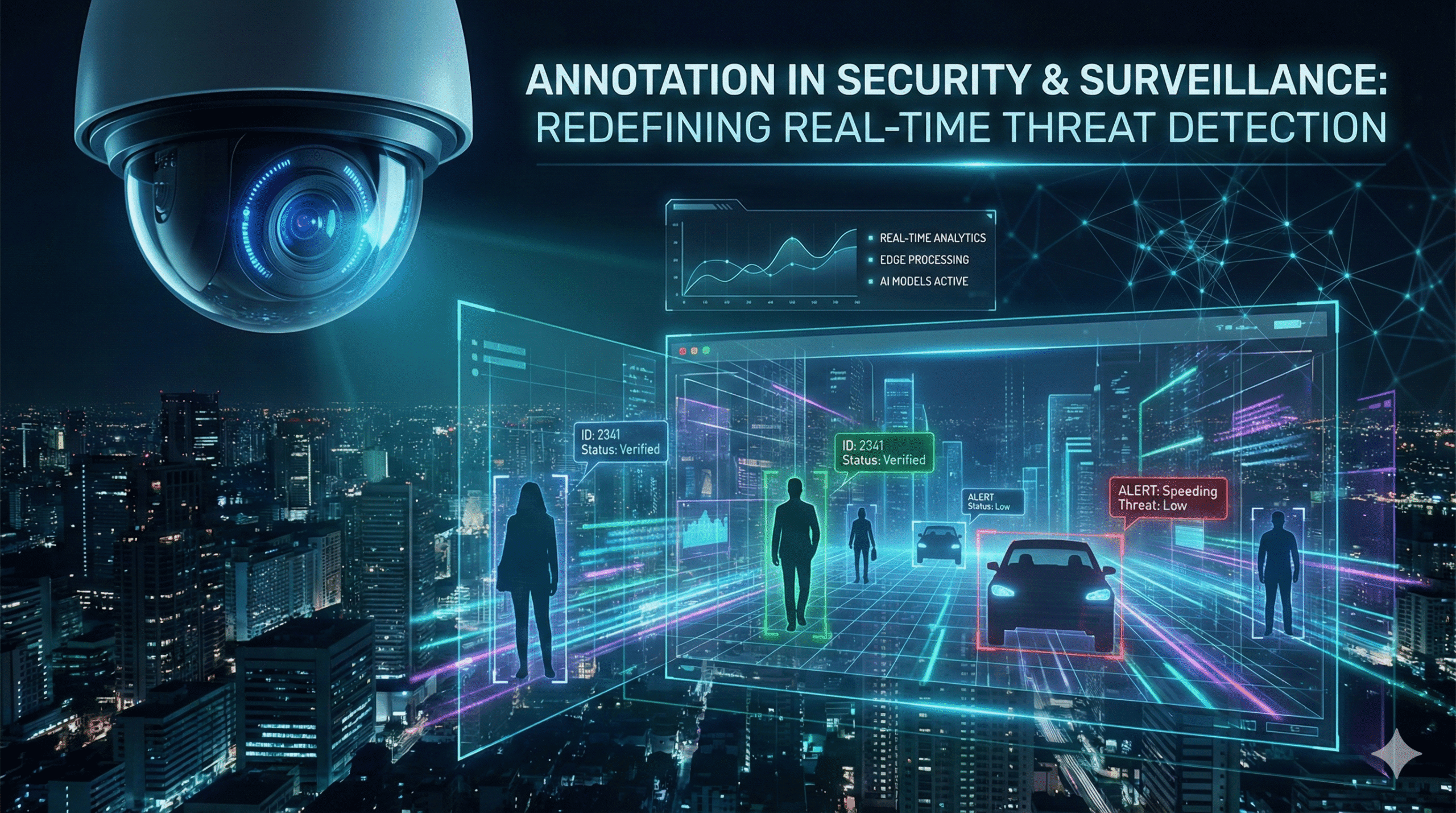
adminAnnotation in Security & Surveillance: Redefining Real-time Threat Detection
Imagine a world where security cameras don’t just record video — they understand it. As soon as a suspicious person loiters near a restricted zone, or an unattended bag is left in a crowded hall, alarms go off instantly. No human doing 24×7 monitoring, no lag, no missed frames.
This isn’t sci-fi. It’s real-time, AI-powered surveillance — made possible by on-the-fly annotation and edge analytics. And at the heart of this revolution lies robust, high-precision annotation infrastructure.
In this post, we dive deep into how real-time annotation — especially using JTheta.ai — is redefining threat detection and transforming security and surveillance forever.
Why Annotation Matters — From Raw Footage to Actionable Intelligence
- From pixels to meaning: Raw video feed is just a stream of images. For AI to interpret this — to spot people, vehicles, abandoned objects, unusual motion — we need accurate labels: bounding boxes, segmentation masks, event tags, temporal labels. This is where annotation comes in.
- Training high-performance models: Modern object detection and tracking models — whether traditional computer-vision or deep learning — rely heavily on annotated training data. Poor annotation quality leads to poor detection accuracy, false positives/negatives, and unreliable monitoring.
- Enabling multi-object tracking (MOT): For surveillance, it’s rarely about one object. We care about multiple people, vehicles, objects — continuously tracked across frames. Annotation data must support temporal continuity (who is who across frames), behavior events, and contextual metadata.
- Scaling to real-world demands: Surveillance environments generate massive volumes of video — night/day cycles, multiple cameras, overlapping fields of view, variable lighting, weather, occlusions. High-quality annotation is essential to ensure training sets capture this diversity.
Thus — annotation is the invisible foundation upon which real-time, reliable security automation is built.
For more on JTheta’s domain expertise, see:
👉 Security & Surveillance Solutions Page: https://www.jtheta.ai/security-surveillance/
Role of JTheta.ai — The Annotation Platform Built for Security & Surveillance
Here’s how JTheta.ai fits into this ecosystem and amplifies the potential of surveillance AI:
- AI-assisted annotation for high precision & speed: Manual annotation — especially across millions of video frames — is labour-intensive, slow, and error-prone. JTheta.ai offers AI-assisted annotation workflows that help pre-label objects, events, or behaviors, which human annotators then validate. This significantly speeds up the process while preserving accuracy.Explore capabilities here:👉 AI + Human Annotation Workflow: https://www.jtheta.ai/
- Scalable and collaborative: For large surveillance deployments (multiple cameras, long-duration feeds), scalability is crucial. JTheta.ai supports secure cloud-based annotation with role-based collaboration — enabling teams to work together efficiently on massive datasets.View industry coverage:👉 https://www.jtheta.ai/security-surveillance/
- Domain-specific support for surveillance use cases: On its Security & Surveillance page, JTheta.ai highlights support for typical tasks in the domain — object detection/tracking, labeling people, vehicles, suspicious objects — with emphasis on confidentiality and compliance relevant to defense and critical security applications.
- Foundation for downstream AI pipelines: Once annotation is done, the structured data can feed into AI/ML pipelines — object detection models, multi-object trackers, anomaly detectors, behavioral analysis systems — enabling real-time analytics, alerts, and automation.
In short: JTheta.ai transforms raw surveillance footage into high-quality annotated data — the first critical building block that enables smart, real-time threat detection systems.
Technical Deep Dive: Real-Time Multi-Object Tracking, Edge Analytics & Automation
To understand what “real-time security automation” entails — and what annotation must support — let’s break down the technical components and challenges, and how annotated data fits in.
🎯 Multi-Object Tracking (MOT)
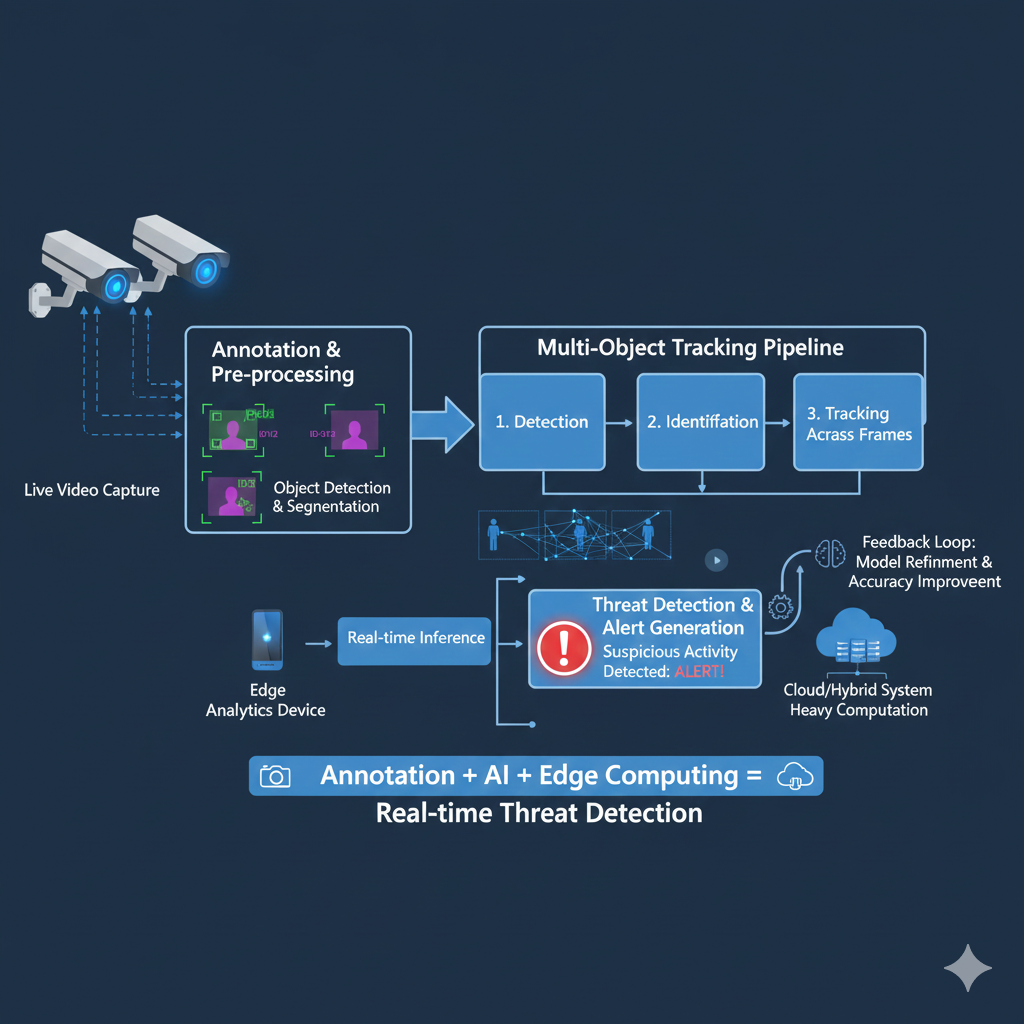
- Object detection → object tracking: A typical MOT pipeline starts with frame-by-frame object detection (people, vehicles, objects) using models like variants of YOLO, SSD, or custom CNNs. Once objects are detected, trackers associate objects across frames to maintain identity over time.
- Challenges in surveillance settings: Occlusions (crowds), overlapping trajectories, varying lighting, low resolution, camera movement — all complicate tracking. Annotated datasets need to include difficult scenarios so that models generalize well.
- Performance & evaluation: Real-time MOT systems are often evaluated on benchmark datasets (like MOT15, MOT16, MOT17) using metrics for detection precision, tracking accuracy, ID switches, etc. Recent research combining traditional background-subtraction + labeling + deep learning shows improved accuracy under constrained compute.
- Annotation implications: For MOT training, annotations must include consistent object identities across frames, bounding boxes (or masks), temporal metadata (frame number, timestamps), and possibly pose or behavior data depending on use-case (e.g. suspicious activity).
🖥️ Edge Analytics & Real-Time Inference
- Need for edge computing: Surveillance setups often consist of many cameras streaming to central servers — but bandwidth, latency, privacy, and cost make cloud-only processing infeasible. Edge computing moves analysis to devices (local servers, edge boxes near cameras), reducing latency and bandwidth.
- Lightweight models & optimization: Running deep neural networks on resource-constrained edge devices requires model optimization, compression, quantization, pruning — or selection of lightweight models. Systems like Transprecise Object Detector (TOD) have shown that adaptive selection of detection models based on scene complexity can improve detection accuracy while preserving real-time speed on edge hardware.
- Scalable video analytics frameworks: Hybrid cloud-edge frameworks (e.g. SurveilEdge) distribute workloads intelligently: edge devices handle lighter detection/tracking tasks, offloading heavy tasks to the cloud when needed — thereby balancing accuracy, latency, bandwidth, and scalability.
- Annotation’s role in edge deployments: Accurate annotation under diverse environmental and lighting conditions ensures the lightweight models trained will generalize well on real-world, edge-deployed camera feeds. Without high-quality annotated data, edge models risk mis-detections, false alarms, or missed threats.
Learn how the platform adapts to industry workflows:
🔄 Security Automation — Beyond Detection & Tracking
- Behavioral & anomaly detection: With annotated data that includes behavioral labels (e.g. “loitering”, “object dropped and left”, “unauthorized entry”), AI systems can be trained for anomaly detection, crowd behavior analysis, intrusion detection, etc. This transforms passive surveillance into proactive monitoring.
- Real-time alerts and integration: Once models are deployed at edge or hybrid nodes, real-time inference enables instant alerts: security teams can be notified when suspicious events occur — enabling rapid response, reducing incident impact.
- Forensics & retrospective analysis: Stored annotated video data becomes a searchable archive. In case of incidents, investigators can quickly filter by object types, time, behavior, and reconstruct events — significantly cutting down investigation time.
- Continuous learning loop: As more footage comes in (new locations, lighting, crowd density), annotation (manual or AI-assisted) can keep enriching datasets, retraining and refining models for evolving scenarios — a self-improving “security-AI feedback loop.”Deep dive into JTheta’s surveillance annotation expertise:👉 https://www.jtheta.ai/security-surveillance/
Challenges, Considerations & Best Practices
While the potential is enormous, building a robust real-time surveillance system powered by annotation + AI has its challenges:
- Data volume & scalability: Surveillance generates huge volumes of video data. Annotating every frame manually is infeasible; AI-assisted annotation + human-in-the-loop review is necessary. This requires scalable annotation infrastructure — where platforms like JTheta.ai shine.
- Annotation quality & consistency: Inconsistent bounding boxes, mis-labelled objects, missing frames or object IDs can degrade model performance badly (false positives/negatives, tracking failures). Ensuring manual QA and clear annotation guidelines is vital.
- Edge deployment constraints: Edge devices have limited compute power, memory, sometimes unreliable network connectivity. Models must be optimized (e.g. quantized, pruned), and there must be fallback or hybrid cloud-edge strategies.
- Privacy, compliance & ethical concerns: Surveillance — especially real-time, automated — raises privacy risks. Data security, access control, user consent, regulatory compliance must be baked in. Annotated datasets must be stored securely; access must be controlled and auditable.
- Edge-case robustness: Rare but critical scenarios — low light, weather changes, occlusion, crowd density, different camera angles — are hard to annotate and train for, but essential for reliable threat detection.
Why This Matters — The Strategic Impact on Security & Surveillance Industry
- Proactive security over reactive: Instead of discovering incidents post-facto by manually scrubbing hours of video — security teams can be alerted immediately as events unfold. Response time drops drastically.
- Scalable across environments: From airports, railway stations, malls, corporate campuses, smart cities to defense installations — annotation + AI + edge analytics makes it feasible to deploy intelligent surveillance at scale.
- Cost & manpower efficiency: Reduces reliance on human guards constantly monitoring video feeds. Annotation and AI take care of the heavy lifting. Human operators intervene only when alerted, drastically reducing fatigue, staffing needs, and human error.
- Continuous improvement & adaptability: As new threats emerge, environments change (lighting, weather, layout), systems can adapt — retraining on newly annotated data, refining models, reducing false positives/negatives over time.
Conclusion — From Pixels to Security Intelligence
In an era of rising security threats and increasing demand for robust, scalable surveillance, annotation is not a “nice-to-have” — it is foundational. Platforms like JTheta.ai enable high-precision, scalable annotation tailored for security & surveillance, bridging the gap between raw video and actionable intelligence.
When combined with multi-object tracking, real-time edge analytics, and behavior detection, such systems turn passive cameras into proactive sentinels — delivering real-time threat detection, automated alerts, scalable deployments, and continuous adaptation.For security professionals, system integrators, AI developers, and decision-makers — investing in annotation infrastructure today is investing in the safety and resilience of tomorrow’s surveillance systems.Learn more or explore collaboration: