 admin
adminWhy “More Data” Is Not the Answer — And What AI Teams Actually Need
In applied AI, “collect more data” has become the default response to almost every performance problem.
Accuracy drops? Add more data.
Edge cases appear? Expand the dataset.
Generalization fails? Scale collection.
This instinct is understandable — but increasingly incorrect.
Across production-grade AI systems, from medical imaging to autonomous perception, data volume is no longer the primary constraint. The limiting factor is data signal quality and learning efficiency.
At JTheta.ai, this pattern appears consistently across real-world deployments: teams that scale data without strategy slow down, while teams that improve data intelligence move faster with less.
The Scaling Fallacy: When Data Growth Stops Helping
In early-stage model development, performance often correlates with dataset size. This relationship weakens rapidly once models encounter real-world complexity.
Empirical research and production benchmarks show diminishing returns beyond a certain data threshold, especially when:
- Label noise increases with scale
- Annotation guidelines drift across batches
- Rare but critical edge cases remain underrepresented
- Data distributions shift faster than datasets are refreshed
At this stage, adding more data frequently increases entropy instead of information.
This is where many AI programs stall.https://www.jtheta.ai/training-data-quality-lessons-from-10000-real-world-ai-projects/
Signal vs. Scale: A More Useful Mental Model
High-performing AI systems are built on high-signal datasets, not merely large ones.
Signal refers to:
- Label precision aligned with model objectives
- Coverage of failure modes, not just common cases
- Consistency across annotators, batches, and time
- Explicit handling of ambiguity and uncertainty
From a statistical learning perspective, noisy labels introduce bias that additional data cannot fully correct. In safety-critical domains, even small inconsistencies propagate into systematic failure.
This is why annotation quality and definition rigor often outperform brute-force data expansion.https://www.jtheta.ai/general-image-annotation-end-to-end-domain-workflow/
Why Edge Cases Drive Production Reliability
Most benchmark metrics reflect average-case performance.
Production failures do not.
Edge cases — rare lighting conditions, sensor artifacts, partial occlusions, anatomical anomalies, or unexpected human behavior — dominate error analysis in deployed systems.
Research in autonomous systems and medical imaging shows that:
- A small fraction of samples often accounts for a majority of high-risk errors
- These samples are frequently under-labeled, mislabeled, or excluded
- Models trained without explicit edge-case prioritization regress under distribution shift
Mature AI teams invert the traditional approach: they optimize for worst-case robustness, not mean accuracy.
This requires intentional data discovery, targeted annotation, and continuous feedback from production failures.https://www.jtheta.ai/general-image-annotation-multimodal-vision-why-jtheta-ai-is-built-for-real-world-ai-systems-2/
Annotation Is Not a Task — It Is a Modeling Decision
Annotation is often framed as a downstream execution step. In practice, it is a model design choice.
Every annotation schema encodes assumptions about:
- What distinctions matter
- What ambiguity is acceptable
- What errors are tolerable
- What the model should ignore
Weak annotation guidelines result in models that learn inconsistent representations, even with large datasets.
At JTheta.ai, annotation workflows are treated as domain-specific knowledge transfer systems, where expert intent is translated into machine-readable structure.
This is particularly critical in:
- Medical imaging (e.g., HU boundaries, anatomical variance)
- Autonomous perception (e.g., object boundaries, temporal consistency)
- Multimodal systems (e.g., image–LiDAR alignment)
Feedback Loops Are the Real Growth Engine
The most important difference between stalled AI projects and successful ones is feedback velocity.
High-performing teams establish closed-loop systems where:
- Model errors automatically surface data gaps
- Failure cases feed annotation priorities
- Quality metrics evolve alongside model objectives
- Dataset composition changes intentionally, not passively
This transforms data from a static asset into a learning system.
Without feedback loops, teams retrain models.
With feedback loops, teams improve systems.
Multimodal AI Makes Data Strategy Non-Negotiable
As AI systems integrate images, video, LiDAR, radar, text, and sensor metadata, complexity scales non-linearly.
Each modality introduces:
- Unique noise characteristics
- Different annotation semantics
- Cross-modal alignment challenges
- Compounded quality risks
Research shows that multimodal systems are only as strong as their weakest data interface. Misalignment between modalities often degrades performance more than model architecture choices.
This is why production-ready multimodal AI requires unified data governance, consistent annotation logic, and modality-aware quality controls.
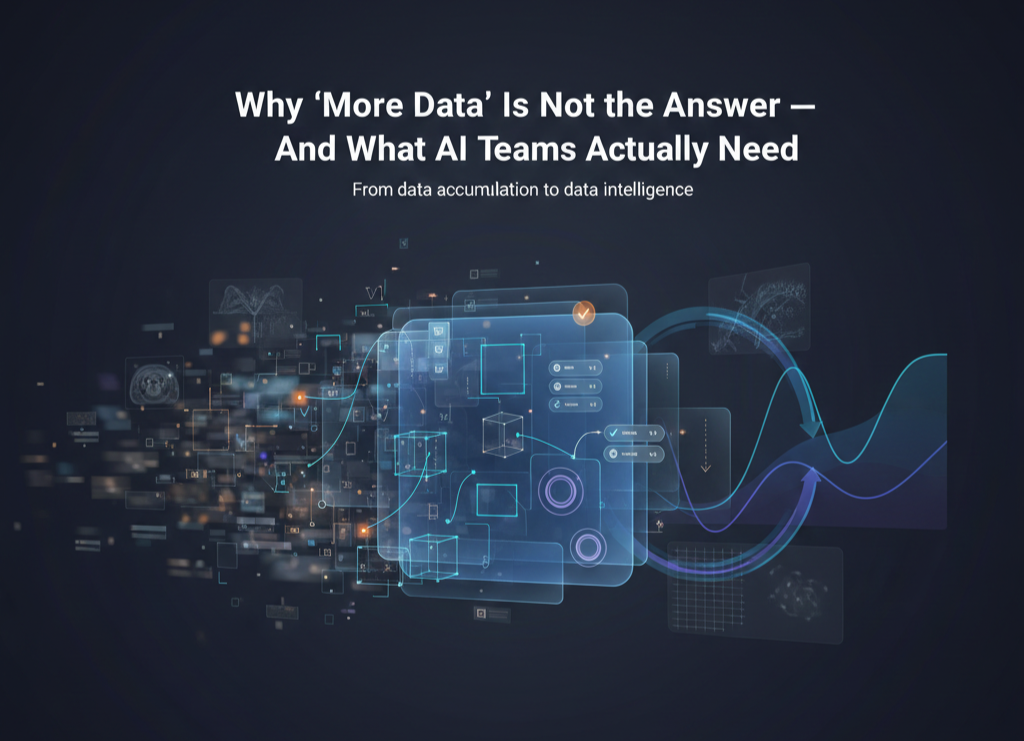
From Data Accumulation to Data Intelligence
The competitive advantage in AI has shifted.
It is no longer about who collects the most data — but who:
- Learns fastest from errors
- Identifies high-impact samples early
- Maintains annotation consistency at scale
- Embeds domain expertise into data pipelines
This transition marks the move from data accumulation to data intelligence.
At JTheta.ai, our focus is enabling this shift — helping AI teams convert raw, complex data into high-signal training assets that directly improve production performance.
Because in real-world AI, success is not defined by how much data you have.
It is defined by how precisely your systems learn from it.
Learn How Teams Build High-Signal AI Systems With JTheta.ai
Turning data into reliable, production-ready AI requires more than scale — it requires structure, domain expertise, and feedback-driven workflows.
Explore how leading AI teams work with JTheta.ai to improve model reliability, accelerate iteration, and operationalize data quality at scale.
→ Industries We Serve
Understand how domain-specific data strategies differ across high-stakes environments.
- [Healthcare AI Solutions]
- [Autonomous Systems & ADAS]
→ Book a Demo
Discuss your data challenges with our experts and see how JTheta.ai supports end-to-end annotation, multimodal workflows, and quality assurance.
https://www.jtheta.ai/book-a-demo/