 admin
adminLiDAR in Industrial Autonomy: Transforming Smart Manufacturing with Intelligent Perception
The future of industrial automation is no longer defined by machines performing repetitive tasks—it is driven by intelligent systems capable of understanding and responding to their environment in real time. Across manufacturing plants, warehouses, logistics hubs, and mining sites, autonomous machines are reshaping operations by improving efficiency, enhancing safety, and reducing operational costs.
At the heart of this transformation is LiDAR (Light Detection and Ranging). By generating precise three-dimensional representations of the environment, LiDAR enables machines to perceive their surroundings with remarkable accuracy. Combined with advanced AI models and high-quality annotated datasets, LiDAR is powering the next generation of industrial autonomy.
The Evolution of Industrial Automation
Traditional industrial automation relied on predefined paths, fixed infrastructure, and rule-based systems. While these approaches increased productivity, they lacked the flexibility to adapt to changing environments.
Today’s industrial facilities are far more dynamic. Human workers, autonomous robots, forklifts, conveyor systems, and inventory are constantly moving, requiring machines to make intelligent decisions in real time.
Modern autonomous systems must be able to:
- Detect and classify surrounding objects
- Navigate safely through complex environments
- Avoid unexpected obstacles
- Track moving equipment and personnel
- Optimize routes and workflows
- Operate continuously with minimal human intervention
Achieving this level of autonomy requires reliable perception—and LiDAR has become one of the most important sensing technologies enabling it.
Why LiDAR Is Essential for Industrial AI
Unlike traditional vision systems that rely solely on camera images, LiDAR captures millions of depth measurements every second, creating an accurate 3D representation of the surrounding environment.
This enables AI systems to understand:
- Object dimensions
- Distance and depth
- Surface geometry
- Environmental structure
- Spatial relationships
- Dynamic movement
LiDAR performs consistently in challenging industrial conditions, including low-light environments, dust, and variable weather, making it a preferred choice for mission-critical autonomous operations.
Industrial Applications Powered by LiDAR
Organizations across industries are using LiDAR to improve automation and operational intelligence.
Warehouse Automation
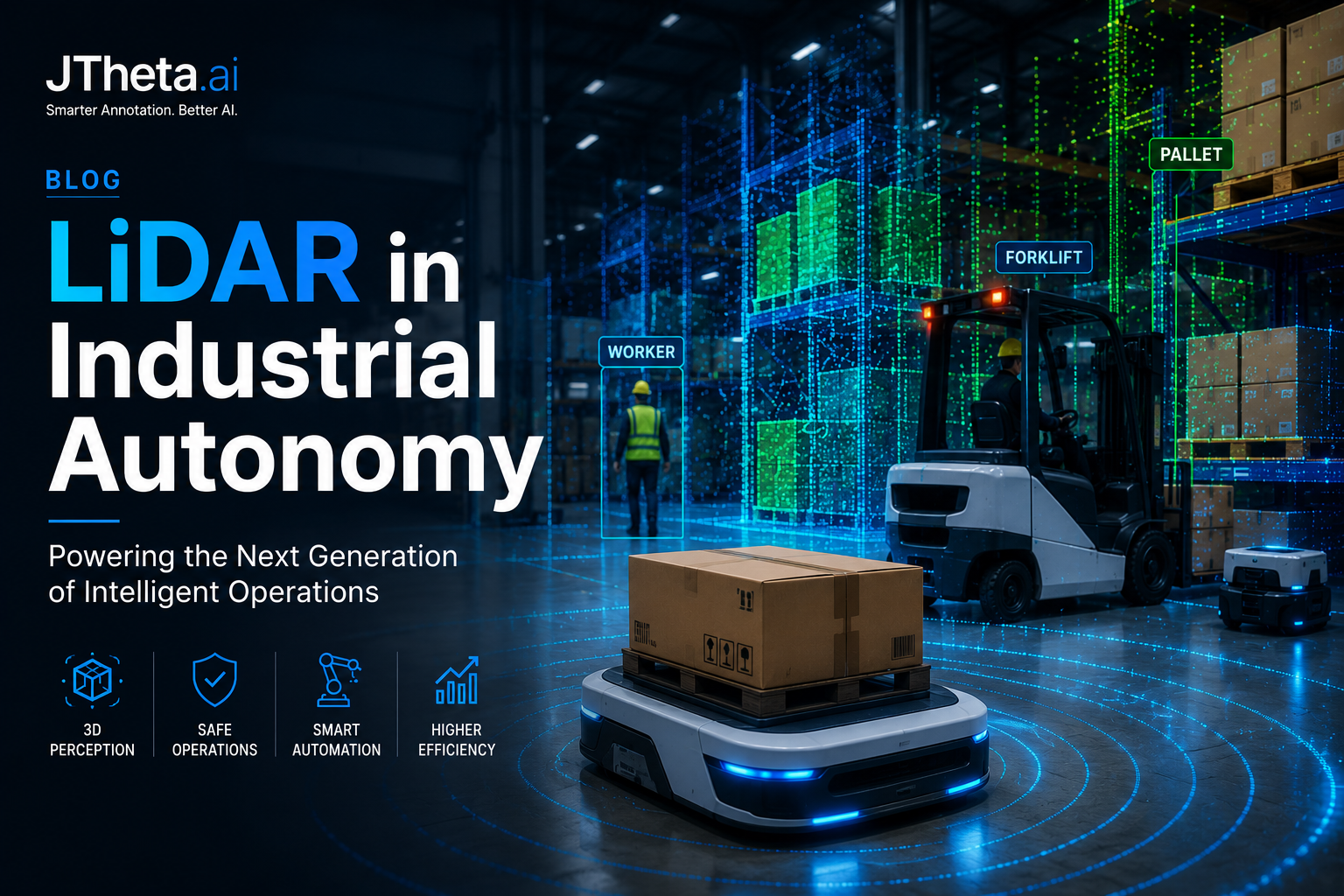
Autonomous Mobile Robots (AMRs) and Automated Guided Vehicles (AGVs) use LiDAR to navigate warehouse aisles, transport inventory, and avoid collisions while operating safely around workers.
Smart Manufacturing
Industrial robots equipped with LiDAR improve assembly line precision, monitor production environments, and optimize manufacturing workflows.
Logistics and Distribution
LiDAR enables autonomous material handling, pallet movement, and route optimization within large distribution centers.
Mining Operations
Autonomous mining vehicles rely on LiDAR to navigate rugged terrain, detect obstacles, and improve operational safety.
Industrial Inspection
Inspection robots use LiDAR to create accurate 3D maps of industrial assets, helping organizations identify maintenance issues before they become costly failures.
Why LiDAR Annotation Matters
LiDAR sensors generate enormous volumes of point cloud data. However, raw sensor data alone cannot train AI models effectively.
Before AI systems can recognize forklifts, storage racks, machinery, workers, or industrial equipment, these objects must be accurately labeled within the dataset.
LiDAR annotation converts raw point clouds into structured training data through tasks such as:
- 3D Cuboid Annotation
- Semantic Segmentation
- Instance Segmentation
- Object Classification
- Multi-Object Tracking
- Sensor Fusion Annotation
High-quality annotations enable machine learning models to understand complex industrial environments with greater accuracy and reliability.
Common Challenges in Industrial Annotation
Creating production-ready LiDAR datasets is often one of the most time-consuming stages of AI development.
Some common challenges include:
Massive Dataset Volumes
Industrial AI projects frequently involve millions of LiDAR frames collected across multiple facilities and operational scenarios.
Dense Industrial Environments
Factories and warehouses contain tightly packed equipment, storage systems, and moving vehicles, making precise annotation more challenging.
Annotation Consistency
Large annotation teams must maintain consistent labeling standards to ensure reliable model training.
Dynamic Objects
Workers, forklifts, robots, and machinery constantly move throughout industrial environments, requiring accurate object tracking across sequences.
Addressing these challenges requires scalable annotation workflows supported by intelligent automation.
How JTheta.ai Enables Industrial Autonomy
JTheta.ai provides a comprehensive annotation platform built for industrial AI teams developing autonomous systems.
Our platform helps organizations efficiently create accurate LiDAR datasets through intelligent annotation workflows and collaborative review processes.
Key capabilities include:
- AI-Assisted LiDAR Annotation
- High-Precision 3D Cuboid Labeling
- Ground Snap for Accurate Object Alignment
- Frame-to-Frame Interpolation
- Multi-Sensor Annotation Support
- Enterprise Collaboration Tools
- Built-in Quality Validation
- Flexible Dataset Export Formats
Whether you’re building autonomous warehouse robots, industrial inspection systems, manufacturing automation, or logistics solutions, JTheta.ai simplifies dataset creation while maintaining the high quality required for production-ready AI.
The Future of Industrial Autonomy
As industries move toward fully autonomous operations, the importance of high-quality perception data will continue to grow.
Organizations that invest in accurate LiDAR annotation today will be better positioned to develop safer, smarter, and more efficient autonomous systems tomorrow.
Reliable perception begins with reliable data—and that starts with high-quality annotation.
Conclusion
Industrial autonomy is transforming the way businesses operate by enabling machines to perceive, understand, and respond to complex environments. LiDAR provides the spatial intelligence needed for these systems to function effectively, but its full potential can only be realized through accurate and scalable annotation.
At JTheta.ai, we’re helping organizations accelerate AI development with advanced LiDAR annotation tools, AI-assisted workflows, and enterprise-ready collaboration features that make building high-quality perception datasets faster and more efficient.
Ready to Accelerate Your Industrial AI Projects?
Empower your autonomous systems with accurate, scalable, and production-ready LiDAR datasets.
Explore JTheta.ai: https://www.jtheta.ai/
Book a Demo: https://www.jtheta.ai/contact