 admin
adminMedical Image Annotation: Powering the future of AI in Healthcare
Medical image annotation is not merely a preprocessing step—it is the ground truth foundation that underpins the reliability, generalizability, and clinical acceptance of healthcare AI systems. From X-rays and CT/MRI scans to whole-slide pathology imaging and 3D multimodal datasets (PET-CT, fMRI, DICOM/NIfTI), annotations provide the supervisory signals that enable deep learning models to detect disease, stratify risk, quantify treatment response, and support precision medicine workflows. The fidelity of these annotations directly impacts model bias, robustness, and downstream clinical integration.
🔹 Key Applications of Medical Image Annotation
1. Early Disease Detection & Risk Stratification
•Pixel-level or ROI annotations in chest X-rays and CT scans enable AI to capture subtle radiographic phenotypes associated with early-stage lung cancer, pneumonia, COPD, and cardiovascular conditions.
•Temporal annotation across longitudinal studies allows models to learn disease progression dynamics, improving risk prediction and preventative screening.
2. Tumor Segmentation & Precision Treatment Planning
•Accurate delineation of tumor volumes in MRI/CT is critical for radiotherapy dose planning, surgical navigation, and survival outcome prediction.
•Advanced annotations incorporate multi-class segmentation (tumor, edema, necrosis) and temporal volumetric tracking to support adaptive therapy regimens.
3. Multi-Organ and Tissue Mapping
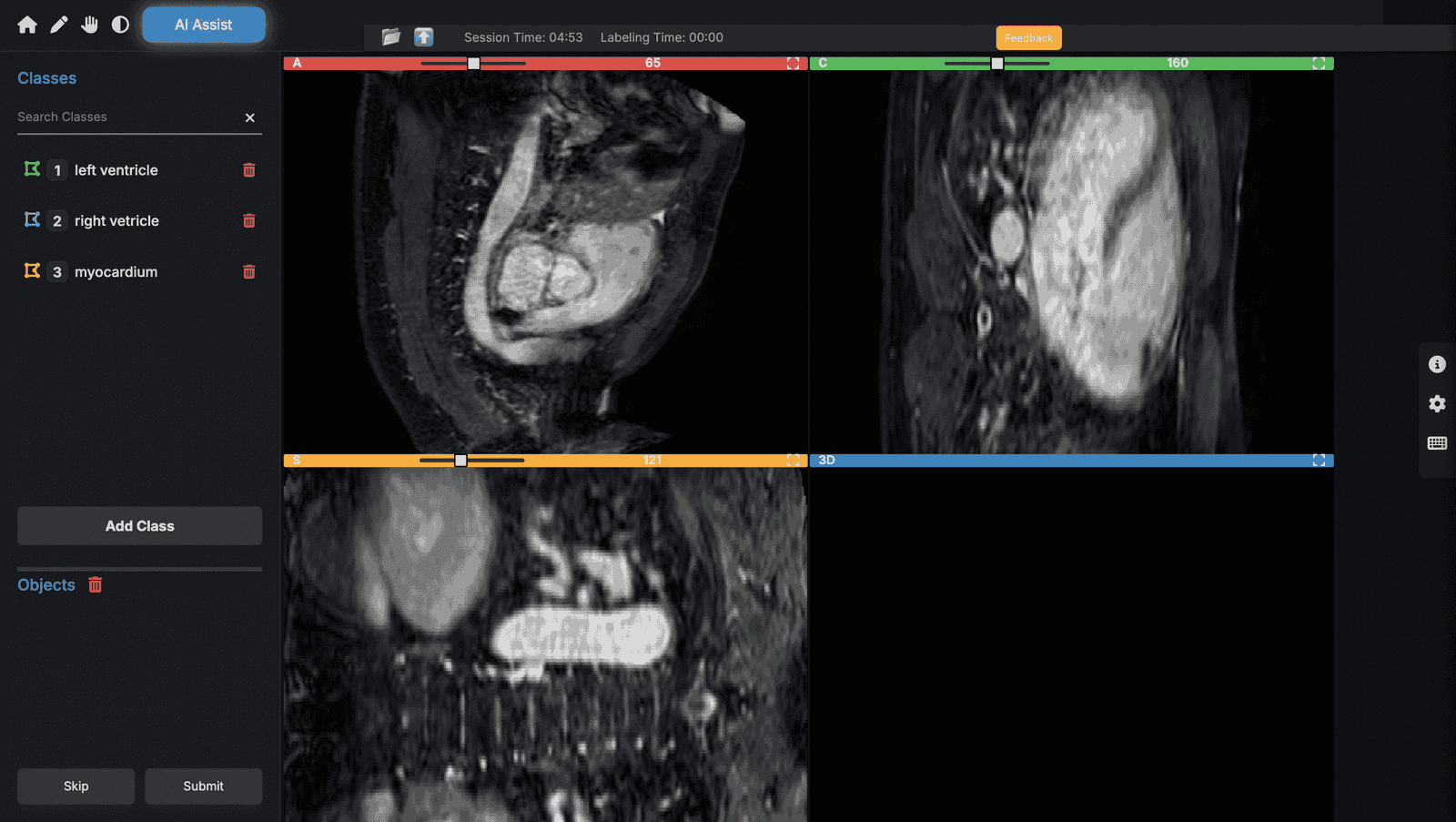
•Fine-grained semantic annotation of anatomical structures (e.g., cardiac chambers, vessels, hepatic lobes) supports 3D reconstruction, biomechanical modeling, and robotic-assisted interventions.
•Cross-modality co-registration (MRI–Ultrasound, PET–CT) annotations enable fusion imaging AI systems, vital for interventional radiology.
4. Digital Pathology & Cellular Analysis
•Whole-slide annotations at the nuclei, gland, or tissue level allow AI to quantify histopathological features like tumor-infiltrating lymphocytes or mitotic counts.
•Weakly-supervised and multiple-instance learning frameworks leverage slide-level labels augmented by expert-provided ROI annotations.
5. Clinical Research & Drug Development
•Annotated datasets serve as surrogate endpoints for clinical trials (e.g., tumor shrinkage, lesion counts).
•In drug discovery, high-throughput annotated microscopy images facilitate phenotypic screening and toxicity prediction.
🔹 Manual vs. AI-Assisted Medical Annotation
| Aspect | Manual Annotation | AI-Assisted Annotation |
|---|---|---|
| Accuracy | Relies entirely on human expertise (radiologists, pathologists). High accuracy, but prone to fatigue errors. | AI assists by pre-labeling regions of interest. Humans only refine, improving both accuracy and consistency. |
| Speed | Time-consuming, especially for complex 3D scans and thousands of images. | Much faster — AI can segment or detect anomalies in seconds, reducing workload. |
| Scalability | Difficult to scale large datasets manually. | Scales easily to large datasets with AI pre-annotations. |
| Cost | Expensive due to heavy reliance on medical experts. | More cost-effective — reduces time experts spend on repetitive tasks. |
| Use Case | Best for small, highly specialized datasets requiring expert-only annotations. | Best for large-scale projects where AI does the bulk work, and experts validate results. |
🔹Our Approach
•AI-Assist Annotation Pipelines: Integration of SAM, MONAI Label, and hybrid inference frameworks (ONNX + PyTorch) for organ/tumor segmentation, landmark detection, and volumetric ROI extraction.
•Human-in-the-Loop Refinement: Expert clinicians validate, correct, and enhance AI-generated annotations, ensuring clinical-grade precision.
•Data-Centric AI: Logging of inter-observer disagreement, IoU/DSC scores, and correction heatmaps to iteratively improve models via active learning and continual training.
•Regulatory-Ready Datasets: Annotation workflows aligned with HIPAA/GDPR, supporting reproducibility, auditability, and downstream FDA/CE compliance.
Conclusion
Medical image annotation is the bridge between raw clinical imaging and deployable AI models. For researchers and engineers, it is the crucible where methodological rigor meets clinical utility. By combining expert knowledge, AI-augmented efficiency, and robust data governance, we unlock scalable annotation pipelines that accelerate the development of reliable, generalizable, and regulatory-compliant AI systems. This synergy makes medical AI not only clinically viable but also transformational for global healthcare delivery.